Hey, I’m Chris — and if you’ve ever heard a sharp bang come from your garage at 6 a.m. and thought a pipe burst or something fell off the wall, there’s a good chance it was actually a garage door spring letting go. Here at Red Crest Garage Doors, we handle Garage Door Repair calls all across Scottsdale, AZ and the Phoenix metro every single day, and spring failures are one of the most common — and most misunderstood — situations we walk into. So let’s slow down and actually talk about what’s going on above your head every time that door moves.
Why Springs Matter More Than You Think
Your garage door isn’t light. A standard two-car door can weigh anywhere from 150 to 350 pounds. Springs do the real heavy lifting — literally. They store mechanical tension and release it to counterbalance that weight so your opener motor doesn’t burn out in six months, and so the door doesn’t come crashing down on your car, your kids, or you.
There are two fundamentally different spring systems used on residential garage doors: torsion springs and extension springs. Knowing which one you have — and what that means for your home — is the kind of thing most homeowners never think about until something breaks. Let’s fix that right now.
Torsion Springs: The Workhorse Above the Door
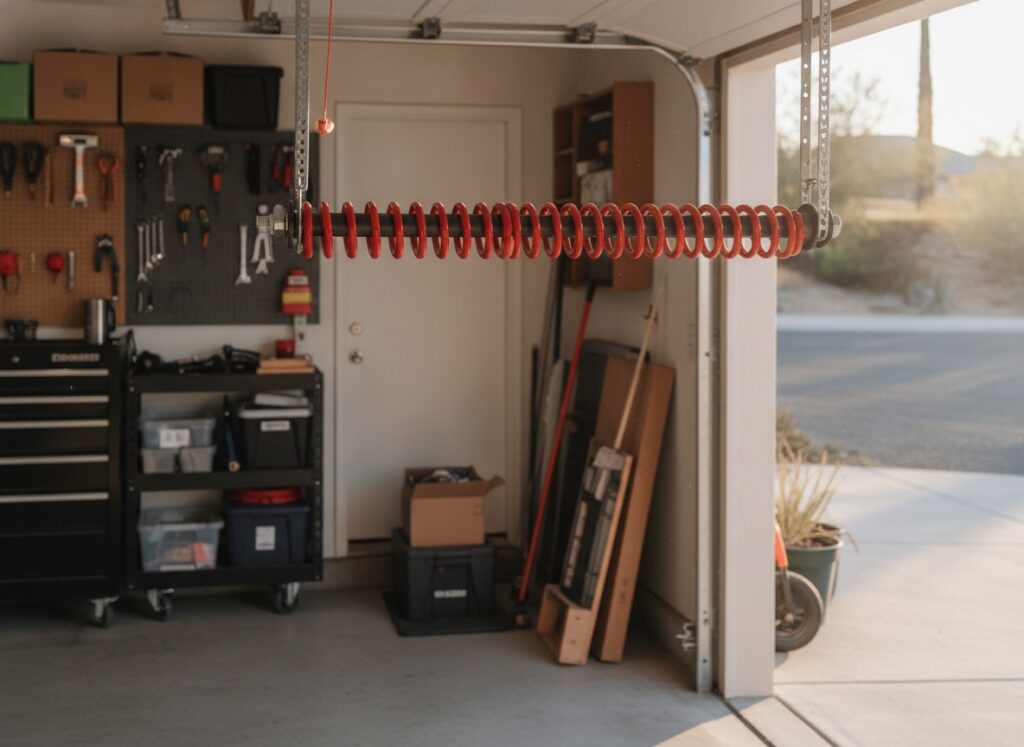
Torsion springs are mounted horizontally on a metal shaft directly above the garage door opening. As the door closes, the spring winds up and stores energy. When the door opens, that stored tension unwinds and does the lifting. They’re compact, powerful, and built to handle more cycles.
If you live in a newer build in North Scottsdale near the DC Ranch area or in a Chandler master-planned community, there’s a solid chance your door came with a torsion system. Builders in the Phoenix metro have leaned toward torsion setups for years because they handle the constant thermal expansion and contraction our desert climate throws at metal hardware.
- Typical lifespan: 15,000–20,000 cycles (roughly 7–14 years of daily use)
- Location: Horizontal bar above the door
- Action: Twists (torques) to store and release energy
- Best for: Heavy doors, high-use households, two-car garages
- Failure mode: Snaps with a loud bang; door drops or won’t open
Extension Springs: The Older, Simpler System
Extension springs run along the horizontal tracks on either side of the door — one per side. Instead of twisting, they stretch (extend) as the door closes and contract as it opens. You’ll find these more often on older homes or lighter single-car doors.
Out in Cave Creek, Fountain Hills, and some of the older neighborhoods tucked off Shea Boulevard in Scottsdale, we run into extension spring setups fairly regularly. They work fine — but they come with a safety consideration worth knowing: if an extension spring snaps without a safety cable running through it, the metal can whip across the garage at serious speed. Always check that those safety cables are in place.
- Typical lifespan: 10,000 cycles (roughly 5–7 years of daily use)
- Location: Along the side tracks, one on each side
- Action: Stretches and contracts to store and release energy
- Best for: Lighter single-car doors, lower ceilings
- Failure mode: Snaps and can recoil dangerously if no safety cable is installed
A broken spring isn’t just an inconvenience — it’s a safety event. Never try to manually force a door open or attempt a DIY spring swap. The stored tension in these components can cause serious injury.
Side-by-Side: Torsion vs. Extension at a Glance
| Feature | Torsion Spring | Extension Spring |
|---|---|---|
| Mounting Position | Above door, center shaft | Side tracks, one per side |
| Cycle Lifespan | 15,000–20,000 | 10,000 |
| Door Weight Capacity | Higher (heavier doors) | Lower (lighter doors) |
| Safety Risk if Broken | Loud snap, door drops | Snap + recoil whip without safety cable |
| Typical Phoenix-Area Install | Newer builds, two-car doors | Older homes, single-car doors |
| Replacement Cost Range | Moderate–Higher | Lower–Moderate |
| DIY-Safe? | No | No |
Signs Your Spring System Is Failing — Right Now
Springs don’t always announce their death with a dramatic bang. Sometimes they go quietly, and you just notice something feels off. Here’s what to watch for in Scottsdale, AZ homes, especially after a hot summer when metal has been expanding and contracting for months:
- The door opens unevenly or one side lifts higher than the other
- You hear a grinding or squeaking noise that wasn’t there before
- The door feels unusually heavy when you try to lift it manually
- The opener strains, runs slower, or reverses immediately after closing
- You can visibly see a gap in the coil of a torsion spring
- The door drops quickly when closing instead of lowering smoothly
If any of those sound familiar, it’s worth getting a professional set of eyes on it before a slow problem turns into a car stuck inside the garage on a Tuesday morning. We’ve gotten those calls from homeowners near Kierland Commons in Scottsdale and as far out as Fountain Hills — and trust us, nobody wants to be late to work because of a spring they noticed squeaking two weeks ago.
Our full garage door inspection checklist for long-term performance walks through exactly what our technicians check on every visit — springs included. It’s worth a read before you schedule anything.
Can You Replace Just One Spring, or Does It Have to Be Both?
Great question — and one we hear all the time. The honest answer: technically you can replace just the broken one, but we almost always recommend replacing both at the same time. Here’s why. Springs age together. If one breaks, the other is usually at a similar point in its cycle life. Replacing one now and having the other snap three months later means you’re paying for a service call twice, and going through the same disruption all over again.
For extension spring systems with two springs (one per side), this is especially true — uneven tension between a new spring and an old one can actually stress the door, the tracks, and the cables. It’s just not worth the short-term savings.
If your door is more than 10–12 years old and you’re already into a spring replacement, it might also be a good time to have us look at whether a full garage door installation makes more financial sense long-term — especially if you’ve been dealing with recurring issues or the door is starting to look dated.
Why Scottsdale, AZ Homeowners Need to Think About the Desert Climate
We’re not in Seattle. Summer temperatures in the Phoenix metro consistently hit 110°F+, and that kind of heat affects metal components differently than mild climates. Springs in AZ homes tend to fatigue faster if they’re not properly lubricated, which is exactly why we always cover spring lubrication as part of our routine garage door maintenance service. A silicone-based lubricant applied twice a year makes a measurable difference in spring longevity out here.
Also worth noting: dust and debris from our desert winds — especially out toward Cave Creek and north of Carefree Highway — can work into the spring coils and accelerate wear. It’s subtle, but it adds up over years.
Not sure if your door had issues closing lately at night? That’s sometimes spring-related too. Check out what we wrote about what it means when your garage door won’t close at night — it covers a few causes people don’t expect.
When to Call a Garage Door Repair Professional — And Why It Shouldn’t Wait
Springs are one of the few garage door components where we genuinely, firmly say: please don’t DIY this. The tension stored in a torsion spring is powerful enough to cause serious injury if the winding bars slip, the spring releases unexpectedly, or the setup isn’t correct. It’s not a matter of skill — it’s a matter of physics and the right tools. Our garage door technicians carry calibrated winding equipment and know exactly how many turns each spring requires based on the door’s weight and drum size.
When you call Red Crest Garage Doors, you’re getting a local team that knows Scottsdale, AZ and the surrounding Phoenix metro — not a national chain dispatching someone unfamiliar with your neighborhood. We give you upfront pricing before anything gets touched. No surprises on the invoice. That’s just how neighbors treat each other.
Whether you’re in Chandler, Fountain Hills, North Scottsdale near Pinnacle Peak Road, or anywhere in between — we’re ready to come out, assess your spring system honestly, and get your door running safely again. Give us a call at (602) 898-8558 or reach out through our contact page and we’ll get you scheduled fast.
Some content on this site is AI-assisted and may not reflect exact current details — please verify with Red Crest Garage Doors at (602) 898-8558. Learn more.